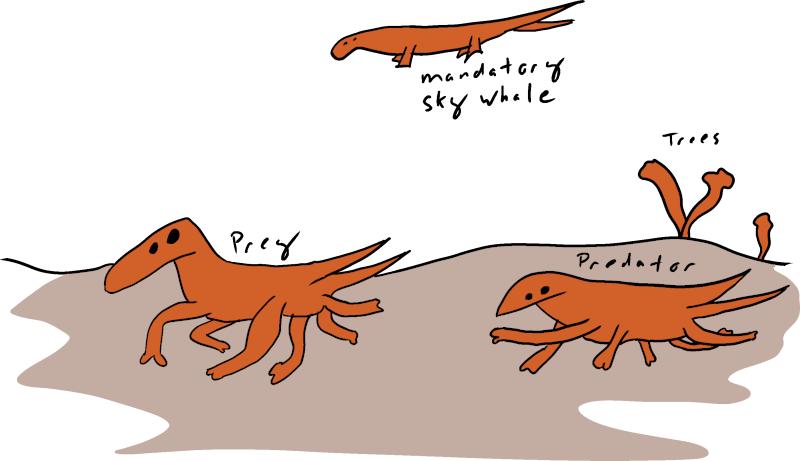
There's a lot of tired tropes in speculative xenobiology and a tendency to focus on a very narrow band of beings:
- The art focuses on charismatic megafauna. Most alien animals portrayed range in size from cats to supermassive larger-than-dinosaur animals.
- There's an overfocus on predators and land animals.
- The ecology and lifecycles portrayed tend to be very simple. There's plants, herbivores, and predators, and they reproduce somehow. Real-life ecologies are much more complex.
- In terms of appearance, there's hardly any fur, feathers, or fat. Creatures are muscly and shrink-wrapped in appearance. Their body plans tend to be minor variations on terrestrial tetrapods.
- Finally, the environments depicted tend to be very sparse and tidy. There are few jungles and many arid plains.
I do think each of these has improved in recent years, but I hope you can see where I'm coming from.
So why does this happen?
Inventing a biology from first principles is hard, especially when you're not a biologist! There's an big desire to keep these creations believable. If you work from references and adapt existing terrestrial fauna, the results are more believable. The focus on land megafauna adds to this, as the need to hold up their weight means that they're pretty constrained in the shapes they can take.
All this results in alien creatures that look far less alien that actual earth creatures! Look at insects, sea creatures, microscopic life - it's far weirder than what you can see in most of these drawings!
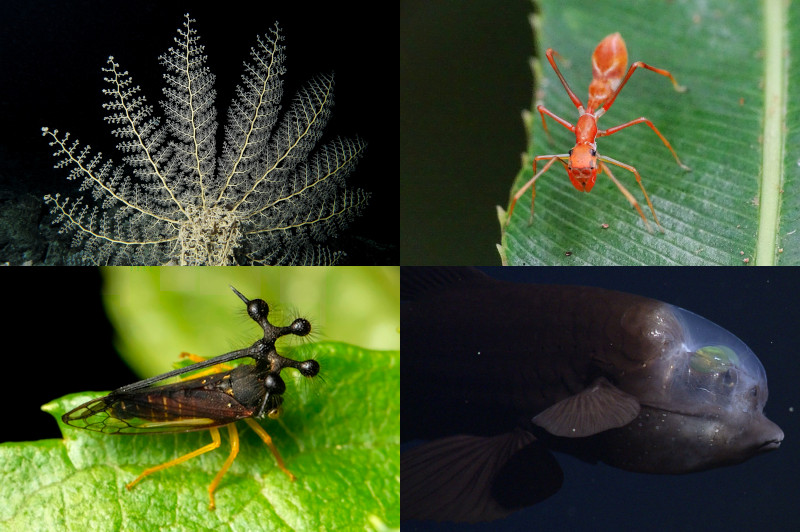
So here's a proposed rule: if your fictional aliens aren't at least as weird as Earth insects, they're not weird enough.
What can we do to fix this?
Look at smaller lifeforms, ocean life, and insects for inspiration. I like to collect weird horrible biology facts, and have appended a list of them below. And think about the underlying mechanics of things and consider alternatives. Even if they don't seem quite as good as the way we're used to doing things on Earth. There's plenty of awkwardness in our own biology, and a lot more variation than you'd think. Complex vision has been invented many times in different ways, for example.
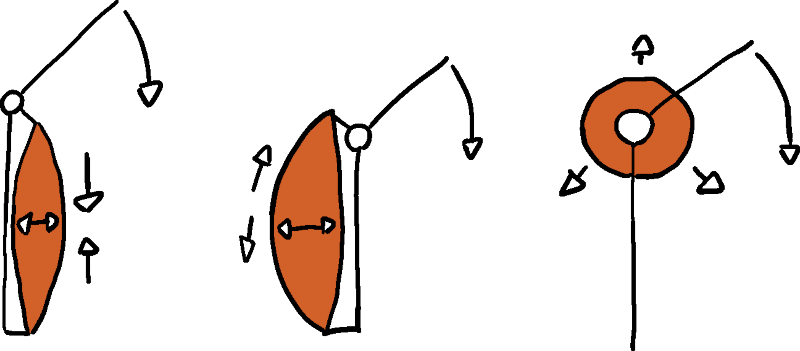
As an example, let's look at muscles: the way muscles work in Earth animals with endoskeletons defines a lot of their look. We've got muscles that work by contraction, becoming thicker when they pull. But what happens to anatomy when muscles push instead of pulling? Or rotate?
One really fundamental thing to look at is body plans. Most Earth animals are basically segmented worms with variously specialized segments and bilateral symmetry. You, o reader, are a segmented worm with specialized segments. (Probably. Please tell me if you are reading this and have a radically different body plan because I'd like to ask some follow-up questions.)
So the layout of Earth animals is that they have one body part after the other, with a clearly defined front and back, left and right, and likely top and bottom. But there's probably no reason the basic shape couldn't be different. At a minimum, the worm could have threefold symmetry. Or the creature is laid out in sectors of a circle, with each segment like the segments of an orange. Or a binary tree, with each segment connected to two smaller sub-segments in turn. Or a dodecahedron. And so on.

Working back up from these different basic shapes, thinking about what kind of things the creatures need to be able to do with their bodies, and making sure you don't tend back towards familiar solutions, should yield some really unique aliens.
But let's take another step back here. Imagine a normal Earth scene: grass, a tree, some animals.
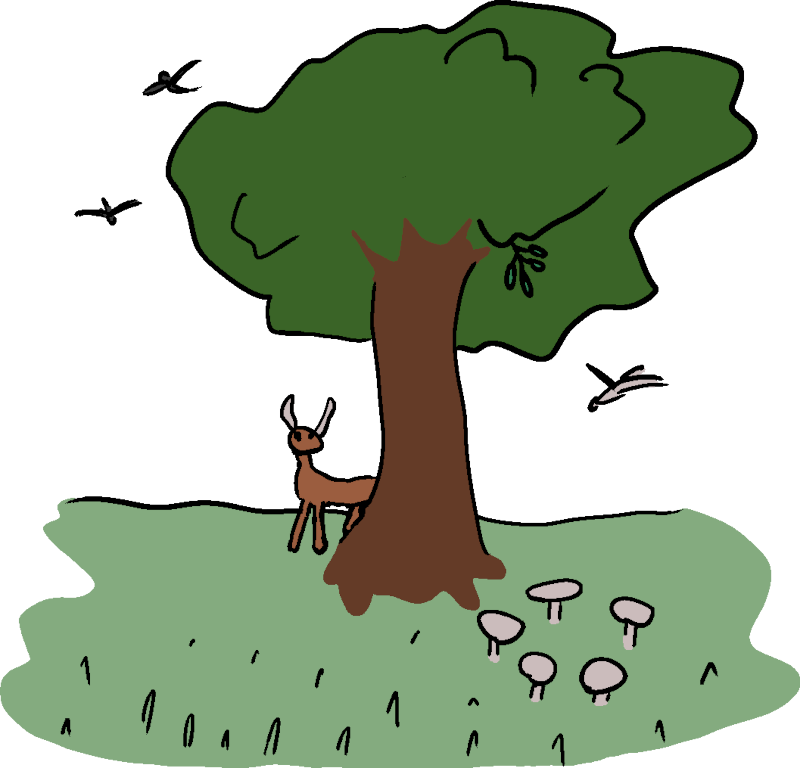
You know how to interpret this scene because you know what kind of lifeforms they are, and where one begins and one ends:
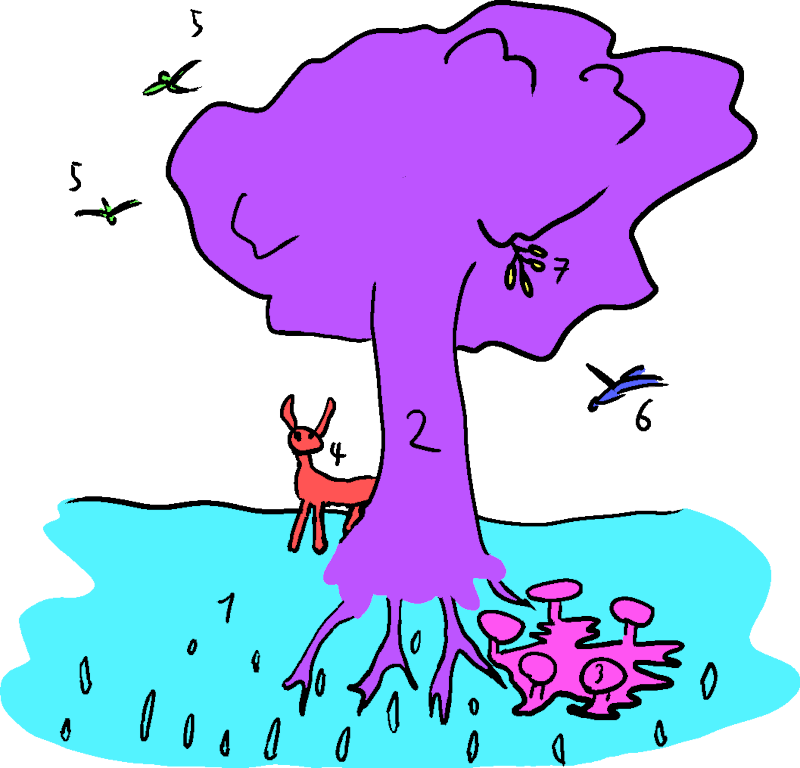
- Grass. Each blade is its own organism.
- A tree with a trunk, branches, and leaves. There are roots underneath the soil.
- Mushrooms that are fruiting bodies connected by an underground mycelium.
- A stag. Its antlers will fall off later in the year.
- Birds nesting in the tree.
- A cuckoo that has laid an egg in one of the nests, parasitizing the reproduction of the other birds.
- Mistletoe, a tree parasite.
The exact same image could equally well represent the following:
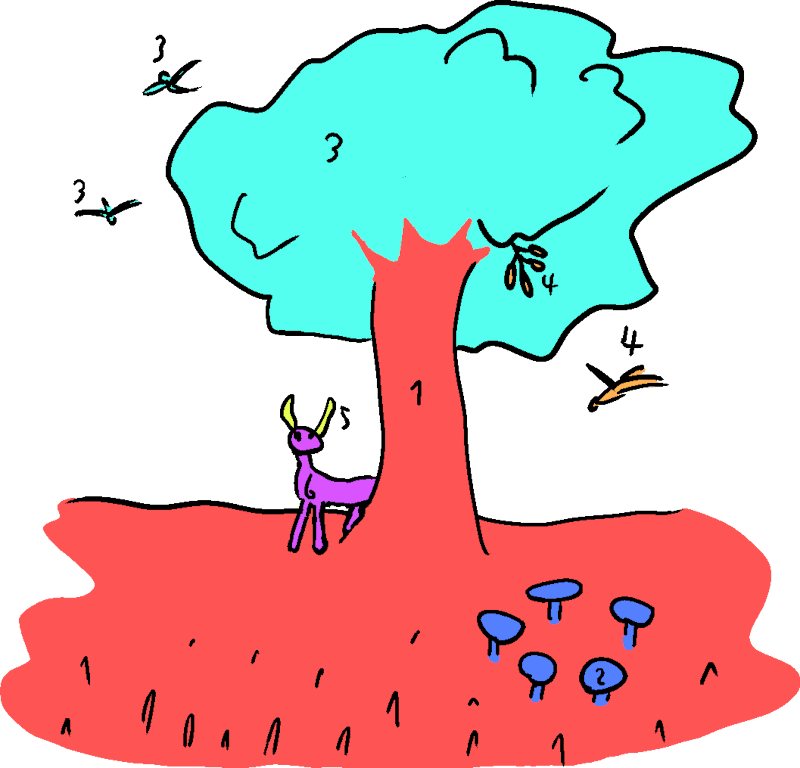
- A single ground-covering organism with many leaves and a tall spike for seed dispersal.
- Monopod predators standing in a social circle, about to hop off.
- Parasitic leaf organisms infesting the spike to get better access to sunlight. The flying things to the left are its mobile gametes.
- Another parasitic leaf organism with its mobile gamete. It exists in a symbiotic relationship with the #3 leaf organisms.
- A four-legged animal with sensory stalks.
- Tiny parasitic leaves that look like fur covering the animal.
My point here is that looking at an alien environment, we might not be able to visually parse what we're seeing. It might dissolve into a mess of shapes and textures with no understandable boundaries.
Anyway, I hope this has been thought-provoking. I do want to try drawing some creatures based on these principles, but as I said, my art skills are rather rusty!
Finally, here's a list of weird animal facts. Warning that some of these are quite gross:
- Starfish larvae have bilateral symmetry that then rearranges itself to become radial.
- Some starfish can reproduce by splitting in half.
- A species of salamander can have offspring with up to three fathers at the same time.
- Polychaete worms reproduce by growing rear body segments with their own eyes and nervous systems that drop off and mate with each other.
- Ants can specialize into becoming food storage and doors.
- Some ants enslave other ants, and some of them need a slave population to survive.
- One ant species clones workers of a different species so it can hybridize with them.
- Ants can pass the mirror test.
- Most plants rely on fungus symbiotes to extract nutrients from the soil.
- African wild dogs vote on whether to go hunting by making sneezing sounds.
- A species of sea slug can cut off its own head as a response to parasitic infection and grow a new body.
- So many parasites: of course there's Cordyceps, the popular mind-control fungus, but there's actually a lot of other behaviour-modifying fungi.
- There's also Toxoplasma Gondii which manipulates the behaviour of its hosts - including humans - to become more reckless and have worse reaction times.
- And Sacculina, a species of barnacle that parasitizes male crabs and makes them behave like females.
- Mimic Octopuses change their color, pattern, skin texture, and movement patterns to impersonate a large variety of creatures and objects.
- The caterpillar of the moth Uraba lugens retains the old head parts of its exoskeleton after shedding, bulding a tower of shells on its head.
- The males of Deep-sea Anglerfishes are much smaller than the females and permanently attach themselves to their mates, fusing their circulatory systems.
- Flatfish! You might be used to their existence, but think about how weird it is to have animals that decided to rotate 90 degrees and migrate one of their eyes to the other side of their head.
- Various animals use the Earth's magnetic field for navigation.
- There are so many different ways to construct eyes.
- Spiders make kites out of their webs to travel in the air.
- Male Darwin's Frogs store their eggs and tadpoles in their mouths until they metamorphose.
- There is vast amounts of life deep below the surface with unusual energy sources and very slow metabolisms.